
AI ethics and climate protection — two agendas that rarely intersect
In most companies, AI governance and sustainability strategy are managed by different teams. The IT department or the CDO handles algorithms, fairness, and data protection. The CSO or the sustainability department tracks CO₂ emissions, water consumption, and social metrics for the ESG report.
This separation is understandable—but it’s a mistake.
Because anyone who takes Responsible AI seriously cannot avoid an uncomfortable question: How sustainable are our AI systems, really—in every sense of the word?
What Responsible AI Really Means
The term “Responsible AI” is often reduced to fairness and transparency. Yet the concept encompasses much more: it refers to AI systems that not only function technically but are also ethically justifiable, socially accountable, and ecologically sustainable.
The European Parliament has enshrined this understanding in the fundamental structure of the EU AI Act. Article 9 requires providers of high-risk AI to implement a risk management system that accounts for harm—not only to individuals but also to the environment. Annex IV requires the documentation of resource consumption by AI systems, including energy and computing capacity.
AI ethics without an environmental perspective is therefore already incomplete under current regulations.
The ecological footprint of AI — in concrete terms
What does this mean in practice? A few key figures that rarely come up in public discussion:
Training a large language model can generate several hundred tons of CO₂ equivalents—comparable to the lifetime emissions budget of several passenger cars. The one-time training effort is just the beginning: ongoing operation—every inference, every API request, every automated process result—multiplies this footprint daily, across the entire company.
Added to this is water consumption from data center cooling. Global hyperscalers like Microsoft, Google, and Amazon report consumption figures of several billion liters of water per year in their sustainability reports. A company that has fully outsourced its AI workloads to the cloud is a participant in this consumption—and thus bears shared responsibility, which may be reflected in Scope 3 reporting under CSRD/ESRS E1.
This is not an argument against cloud AI. It is an argument for understanding, measuring, and strategically managing this footprint.
Why the two go hand in hand
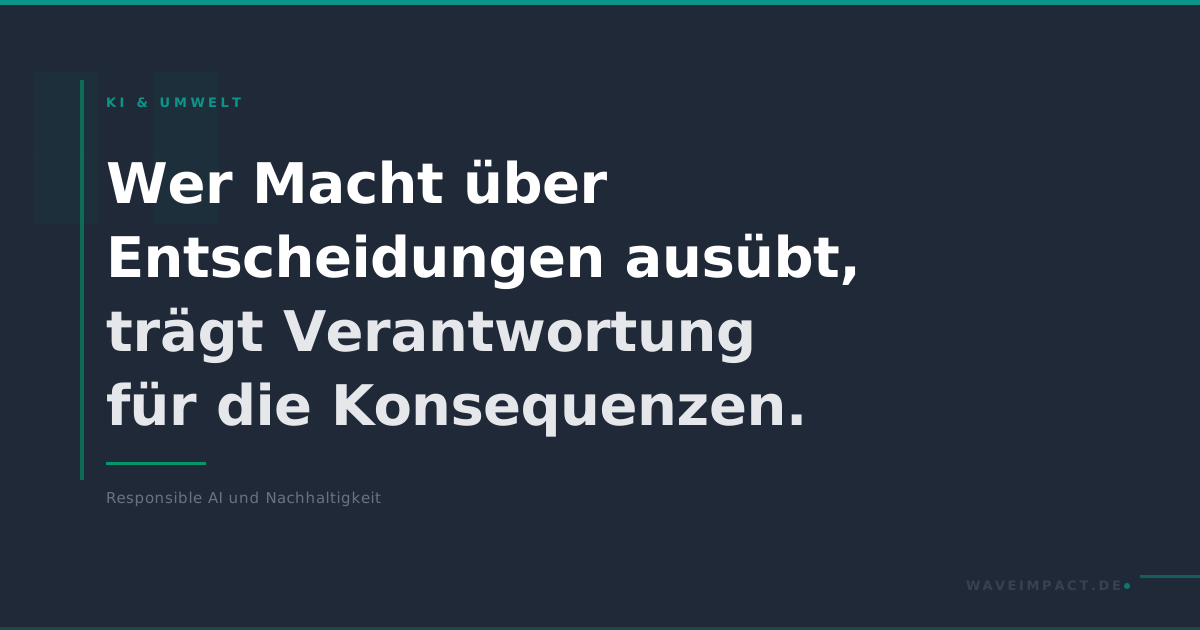
The deeper connection between AI ethics and environmental protection lies not only in regulation. It lies in a shared fundamental principle: whoever exercises power over decisions—whether regarding people or natural resources—bears responsibility for the consequences.
AI systems make millions of decisions every day: regarding creditworthiness, hiring, healthcare, logistics routes, and energy optimization. Behind each of these decisions lies energy consumption. And behind this energy consumption lies a climate impact.
Those who wish to act fairly must also act ecologically. Those who wish to act ecologically must understand the systems operating on their behalf.
This is especially true for companies that take their purpose seriously. B Corps, Economy for the Common Good enterprises, and other values-driven organizations have publicly committed to combining economic activity with social and environmental responsibility. When these companies use AI without fully understanding its impacts, a gap emerges between aspiration and reality—one that will become apparent sooner or later.
What this means for companies
The good news: Integrating AI governance and sustainability strategy is feasible. And it is not merely a compliance task—it is a strategic opportunity.
Specifically, this means:
Making AI workloads visible. Which AI systems are in use? Where are they running? How much energy do they consume? An AI inventory is a prerequisite for any meaningful governance—and for CSRD-compliant reporting.
Collect environmental metrics. Tools such as the Green Software Foundation’s SCI (Software Carbon Intensity) or CodeCarbon enable measurement at the workload level. This data belongs in ESG reporting—as Scope 3 emissions if the AI workloads run via external cloud providers.
Integrate governance and sustainability strategy. This means: the same framework, the same cadence, the same reporting lines. AI ethics and environmental responsibility are not parallel worlds—they are two dimensions of the same governance standard.
Examine reduction strategies. Model compression (quantization, distillation), batch timing, provider selection based on energy mix—there are concrete levers to reduce the AI footprint without sacrificing system performance.
Responsible AI as a holistic practice
Responsible AI is not a checklist item. It is an attitude toward the people affected by AI decisions, and toward the planet that supports the physical infrastructure of these decisions.
For companies that want to remain true to their values, this is not an academic debate. It is an operational question: Do we know what our AI does—and what it costs?
Anyone who has not yet answered this question has a blind spot in their own sustainability standards.
This article is part of the waveImpact blog series “AI & Environment”—a series on the ecological dimensions of AI use in companies. For further reading, we recommend: “What is Responsible AI?” and “EU AI Act Timeline 2026”.
Valentin José Mayr is the founder and managing director of waveImpact GmbH, a Responsible AI consulting firm based in Bremen. He holds a Doctor of Business Administration (Data Science) and is an IHK-certified AI Compliance Manager.
Last updated: April 30, 2026. This article is for general information purposes only and does not replace legal or environmental advice.