
What is Responsible AI?
And why it has more to do with your values than with regulation
Many companies are encountering the topic of responsible AI for the first time through the EU AI Act. That’s understandable—but it’s the wrong starting point. Responsible AI doesn’t begin with legal provisions. It begins with the question of what kind of company you want to be.
AI has been here for a long time—the question is whether it’s right for you
Anyone running a business today uses artificial intelligence, often without calling it that: in applicant screening, customer analysis, credit checks, production control, and customer service. The tools are available, the promises are big, and the competitive pressure is real.
At the same time, unease is growing among many entrepreneurs, not toward the technology itself but toward how it is used. Anyone who publicly commits to sustainability, fairness, or social responsibility—in ESG reports, corporate communications, and daily operations—senses that AI does not automatically align with these values. It can reinforce them or undermine them.
Responsible AI is an attempt to bridge this gap.
What Responsible AI Actually Means
The term sounds like yet another compliance requirement. In fact, it describes something more fundamental: a framework for developing and deploying AI systems that ensures fairness, transparency, security, and human oversight.
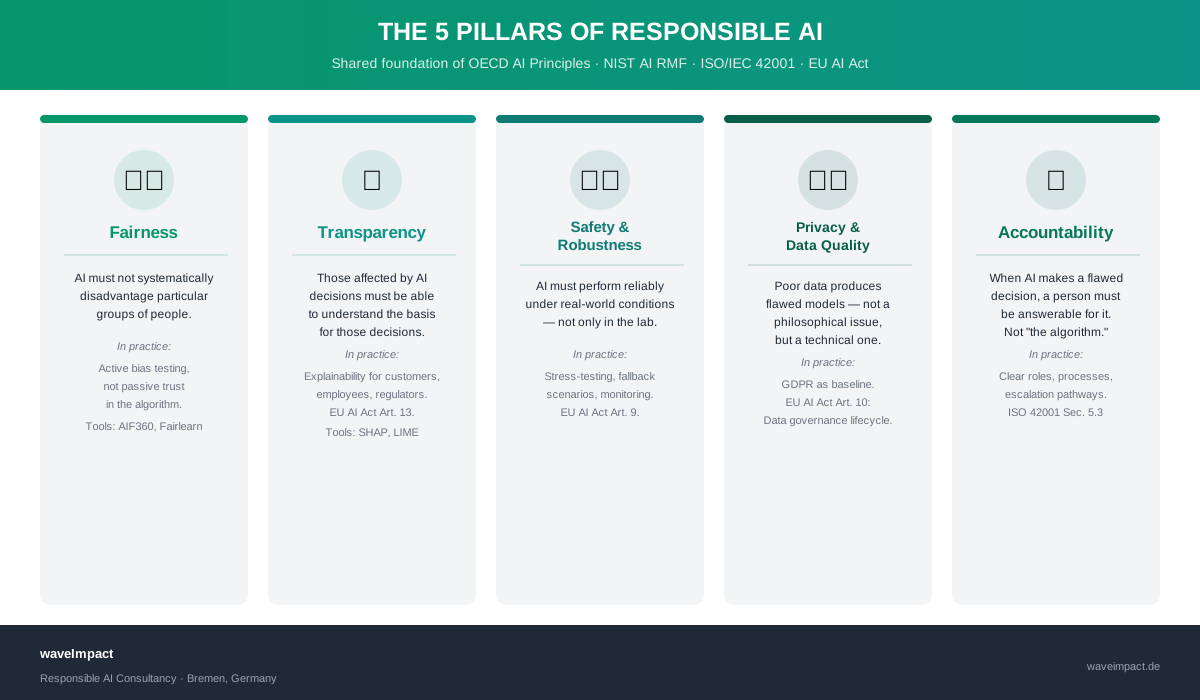
The common frameworks—from the OECD to the NIST AI Risk Management Framework to ISO/IEC 42001—agree on five core principles:
Fairness means that an AI system does not systematically disadvantage certain groups. That sounds obvious, but it isn’t. A recruiting tool trained on historical application data reproduces the biases of the past—not out of malice, but because of mathematics. Fairness in AI requires active scrutiny, not passive trust.
Transparency does not mean that everyone must be able to read the source code. But anyone affected by an AI decision—whether as an applicant, customer, or employee—should be able to understand the basis on which the decision was made. The EU refers to this as explainability. In practice, this means: Can I explain to a customer why their application was rejected? Can I justify to the works council how the shift scheduling tool sets priorities?
Security and robustness ensure that AI systems function reliably under real-world conditions—not just in the lab. A system that delivers completely different results with slightly altered input data is not robust. A system that has no fallback mechanism in case of failures is not secure.
Data protection and data quality form the foundation of any responsible AI. Poor data produces flawed models—this is not a philosophical question, but a technical reality. The GDPR already sets guidelines here, which are now being expanded specifically for AI systems by the EU AI Act.
Accountability answers the simplest and most important question: Who is responsible? If an AI system makes a problematic decision, there must be a person who can take responsibility for it—not the technology or the algorithm. This requires clear governance structures: roles, processes, and escalation pathways.
Why compliance alone is not enough
The core provisions of the EU AI Act will take effect on August 2, 2026. It classifies AI systems by risk and requires providers and operators to ensure documentation, risk management, human oversight, and transparency. This is important and long overdue.
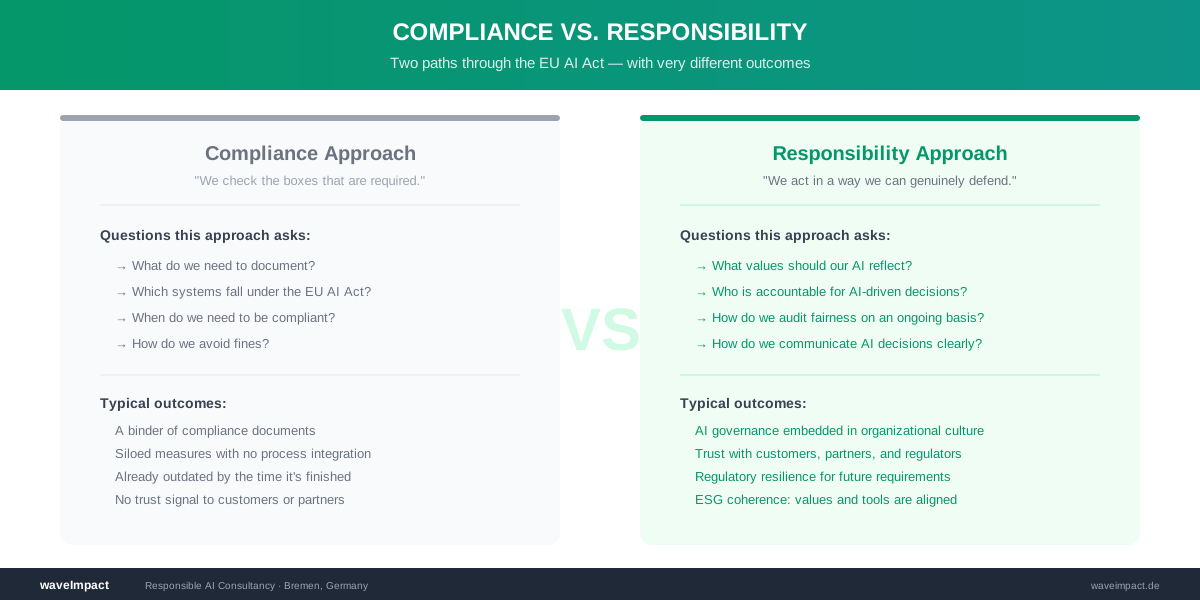
But anyone who views Responsible AI solely as a compliance project is making the same mistake many companies made with the GDPR: checking off the compliance box and then carrying on as before. The experience from 2018 shows what happens.
Companies that treated the GDPR as a mere formality are now struggling with a patchwork of data protection measures that are poorly integrated into their actual processes. Companies that used the GDPR as an opportunity to seriously rethink their data architecture now have more resilient systems—and greater trust from their customers.
The EU AI Act offers the same choice. The question is whether you’ll take it.
Responsible AI as a Strategic Management Tool
A well-thought-out Responsible AI framework is not a brake on innovation. It is a steering tool. It helps companies decide which AI systems they want to use—and which they don’t. Which risks they are willing to take—and which they aren’t. How they communicate about AI decisions—both internally and externally.
This is not a question of size. Mid-sized companies with 50 or 200 employees make AI-supported decisions every day—about suppliers, prices, candidates, and credit lines. Even if the underlying system is a standard product from a major provider: The decision to use it lies with the company. And so does the responsibility.
For companies that already have an ESG framework—whether through CSRD reporting requirements, GWÖ certification, or their own sustainability strategy—Responsible AI is not an external addition. It is a logical extension of the existing value framework into the realm of digital tools.
What this means in concrete terms: Three entry points
You don’t have to start from scratch. Three entry points are realistic and immediately actionable for most companies:
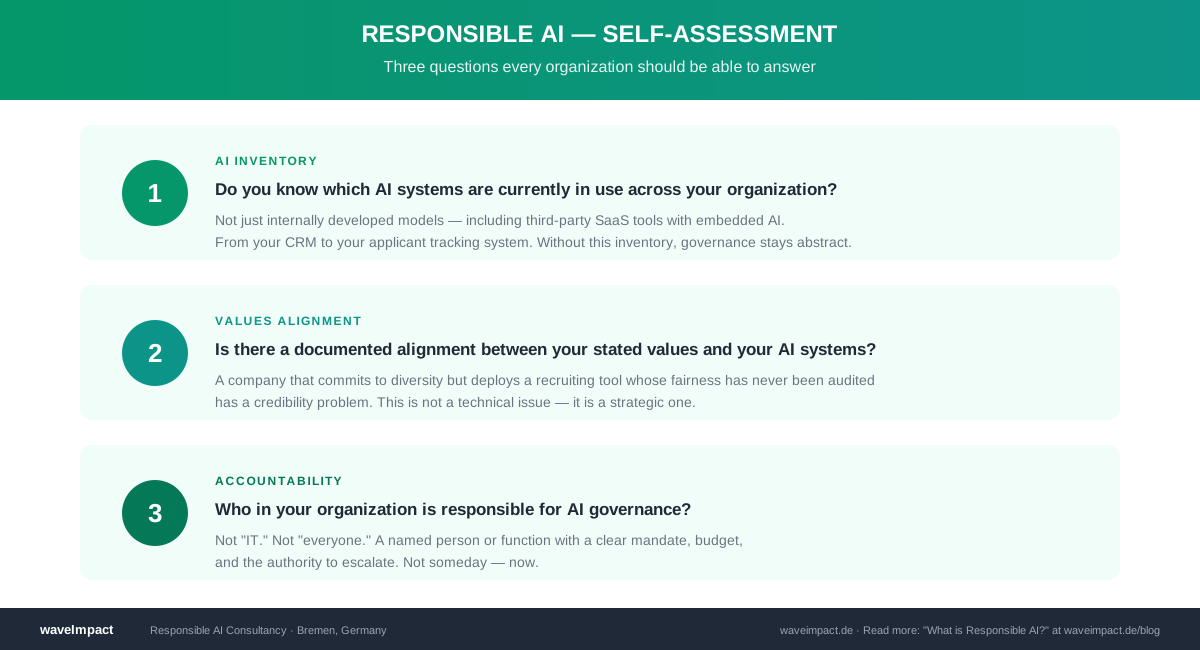
- Create an AI inventory: Which AI systems do we use today—directly or indirectly? Which decisions do they support or automate? Without this overview, any governance discussion remains abstract.
- Conduct a risk classification: Which of these systems influence decisions about people? Which ones fall under the EU AI Act—today or in the future? Which ones are relevant under data protection law?
- Clarify responsibilities: Who in your company is responsible if an AI system delivers erroneous or undesirable results? This question is uncomfortable—but it must be answered before an incident occurs.
These are not technical tasks. They are management tasks. They do not require programming skills, but rather structured thinking, clear communication, and a willingness to assign responsibility.
A personal assessment
I have been studying the use of AI in companies for years—what works and what goes wrong. My conviction: The companies that will stand out in an AI-saturated market over the next three to five years are not the ones with the most powerful models. They are the ones that develop the most confident approach to using them.
In this context, sovereignty means knowing what you’re using, understanding what the system does, and being able to explain why you made that decision—to customers, partners, and employees, and in a few years, likely to regulatory authorities as well.
Responsible AI isn’t the slower path. It’s the more resilient one.
Next Step
Schedule an initial consultation (30 minutes, free):